
 ES
ES

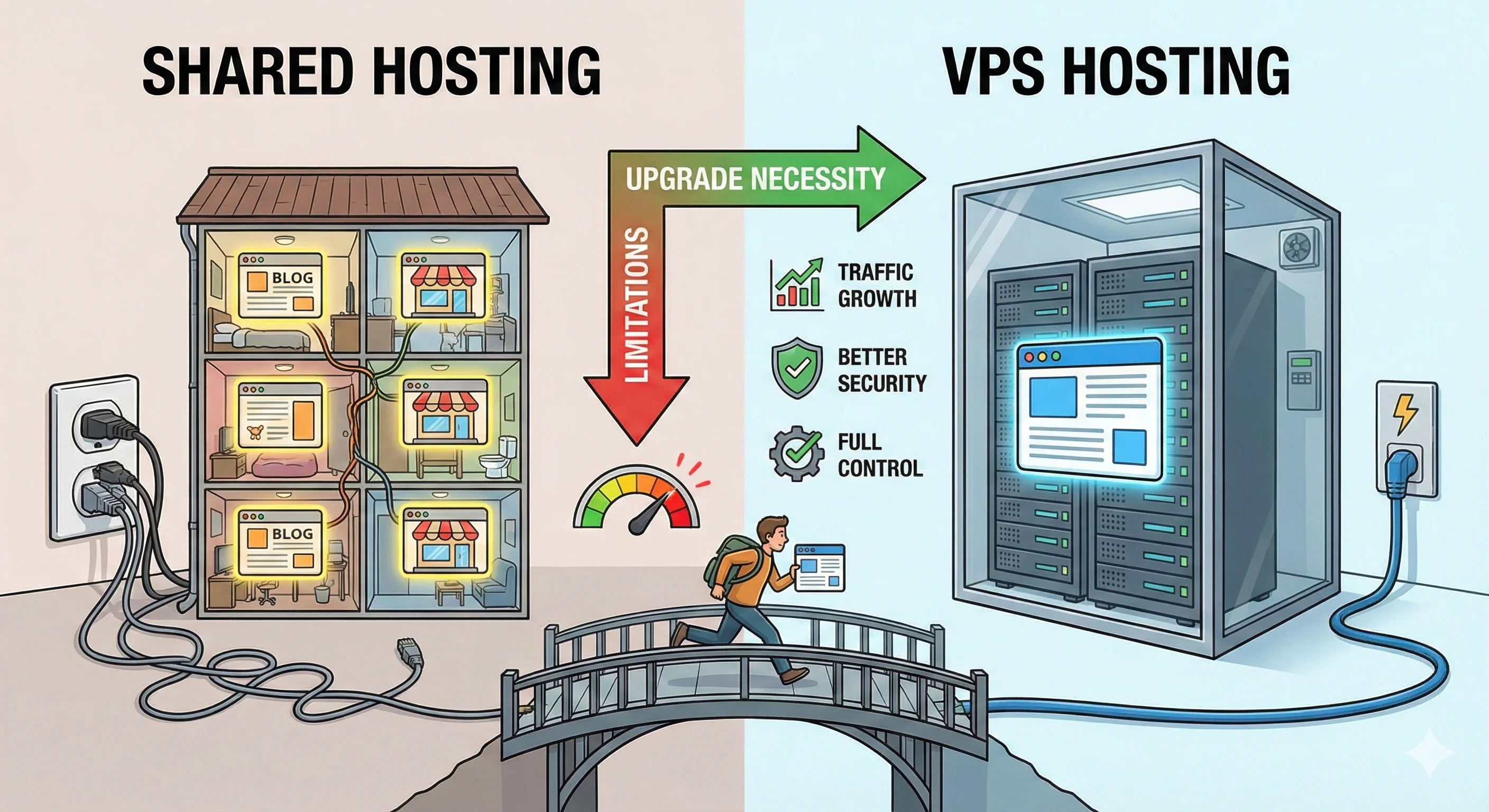
Shared Hosting vs VPS: When an Upgrade Becomes a Necessity
Many new websites and business projects start their journey on shared hosting. It’s an understandable choice: it’s simple, affordable, and doesn’t require deep knowledge of server administration. However, any platform eventually runs into a natural ceiling of capabilities.
Let’s take a closer look at how shared hosting and VPS actually differ — and, most importantly, how to tell when your site has outgrown its initial stage and is ready for the next level.
Shared Hosting
Shared hosting is essentially renting space on a single server that is used simultaneously by dozens or even hundreds of clients. For small and medium-sized websites, this is an excellent starting point. You pay a relatively small fee, don’t have to worry about technical maintenance, and get a standard set of tools — email, a control panel, and backups.
For a typical landing page, corporate website, blog, or small online store, these conditions usually cover basic needs:
-
minimal technical effort;
-
automated updates;
-
built-in protection against the most common threats;
-
predictable and low costs.
However, this convenience comes with a key limitation: all resources are shared among all users. If a neighboring site on the same server suddenly puts a heavy load on the system, your website will feel the impact as well.
Virtual Private Server (VPS)
A VPS works differently. You get a separate virtual machine that functions like a full-fledged server with clearly allocated resources, independent of other tenants.
-
access to system-level settings;
-
the ability to choose the operating system;
-
freedom to install applications and modules;
-
flexible control over performance and security.
When Does Shared Hosting Stop Being Enough?
In most cases, the first warning signs appear in three areas:
-
Performance.
The site starts to slow down, pages occasionally fail to load, or 500 errors appear — these are clear red flags. Even with moderate traffic, problems on a shared server can affect your users. -
Functional limitations.
On shared hosting, you can’t install specific modules, fine-tune PHP settings, or use custom caching tools. Everything follows a fixed template. -
Security and isolation.
Shared hosting is designed for the mass market. If one site on the server gets infected, the entire server can be penalized by search engines or blocked by IP. With a VPS, this risk is eliminated: your server is isolated from other users’ resources.
Clear Growth Milestones: When the Choice Is Obvious
Moving to a VPS makes sense if:
-
the site consistently has more than 500–1,000 unique visitors per day;
-
traffic spikes occur from time to time (for example, during promotions);
-
you need custom monitoring systems, scripts, or non-standard software versions;
-
there are requirements for storing or transmitting personal or encrypted data;
-
you plan to launch new projects or subdomains on the same infrastructure;
-
reputation and stability are critical (especially for e-commerce, SaaS, and service platforms).
In practice, many projects push shared hosting to its absolute limit. But when response time and stability become critical, saving money can cost more in the long run: failed orders due to errors, lost search rankings because of slow load times, and declining user trust.
Real-World Scenarios Where VPS Becomes Essential
A growing online store
You start with a small catalog, and basic hosting is enough. Then you add ERP integration, online payments, expand the catalog to thousands of items, run regular promotions, and connect analytics and marketing modules. The site slows down, the cart occasionally freezes — shared hosting can no longer cope. In this situation, moving to a VPS is mandatory. It allows you to configure your own caching, install required PHP extensions, and maintain fast response times under load.
Projects with user accounts or internal services
Internal CRMs, corporate portals, booking systems, or learning platforms require not only availability, but also security. On shared hosting, it’s difficult to ensure the necessary level of privacy and adapt the software to internal workflows.
Rapid traffic growth
If your content or platform consistently attracts thousands of users per day, shared hosting starts to fail: pages load slowly, bounce rates increase, and downtime becomes more frequent. A VPS is easy to scale — you can choose a plan with the required specs or add resources as needed.
Need for custom configurations
Does your project require a specific server software version, a rare library, or custom Nginx or Apache settings? Shared hosting administrators won’t allow this, but on a VPS you have full freedom to customize.
That said, moving to a VPS isn’t just a plan upgrade — it’s a new level of responsibility. You’ll either need to handle server administration yourself (or hire a specialist), or choose a managed VPS with technical support. Full control opens up new possibilities, but it also requires time and learning.
How to Prepare for a VPS Migration
Analytics and audit
Start by analyzing your current load and real requirements. Estimate how much RAM and CPU time the site needs for stable operation, with room for growth.
Test migration
Before the final move, set up a VPS in test mode. Transfer a copy of the site, check all modules, performance, domain settings, and email delivery.
Backup configuration
Any server can fail and lose data. Automatic backups are essential for peace of mind. Set them up and verify they work before migrating, so recovery is quick in case of issues.
Smooth transition
Ideally, the migration is done at night. The old site remains online while you configure and test the new server. Once everything is ready, traffic is switched to the VPS by updating DNS records.
Updates and maintenance
Plan regular software updates, set up monitoring (for example, with Zabbix or Grafana), and keep an eye on performance metrics and server security.
Conclusions
Choosing between shared hosting and a VPS is always a balance between budget, flexibility, and control.
For small and medium-sized websites, especially at an early stage, shared hosting remains a reasonable option.
Once the business grows, technical limitations become apparent, and higher performance and stronger security guarantees are required, a VPS becomes the obvious next step.